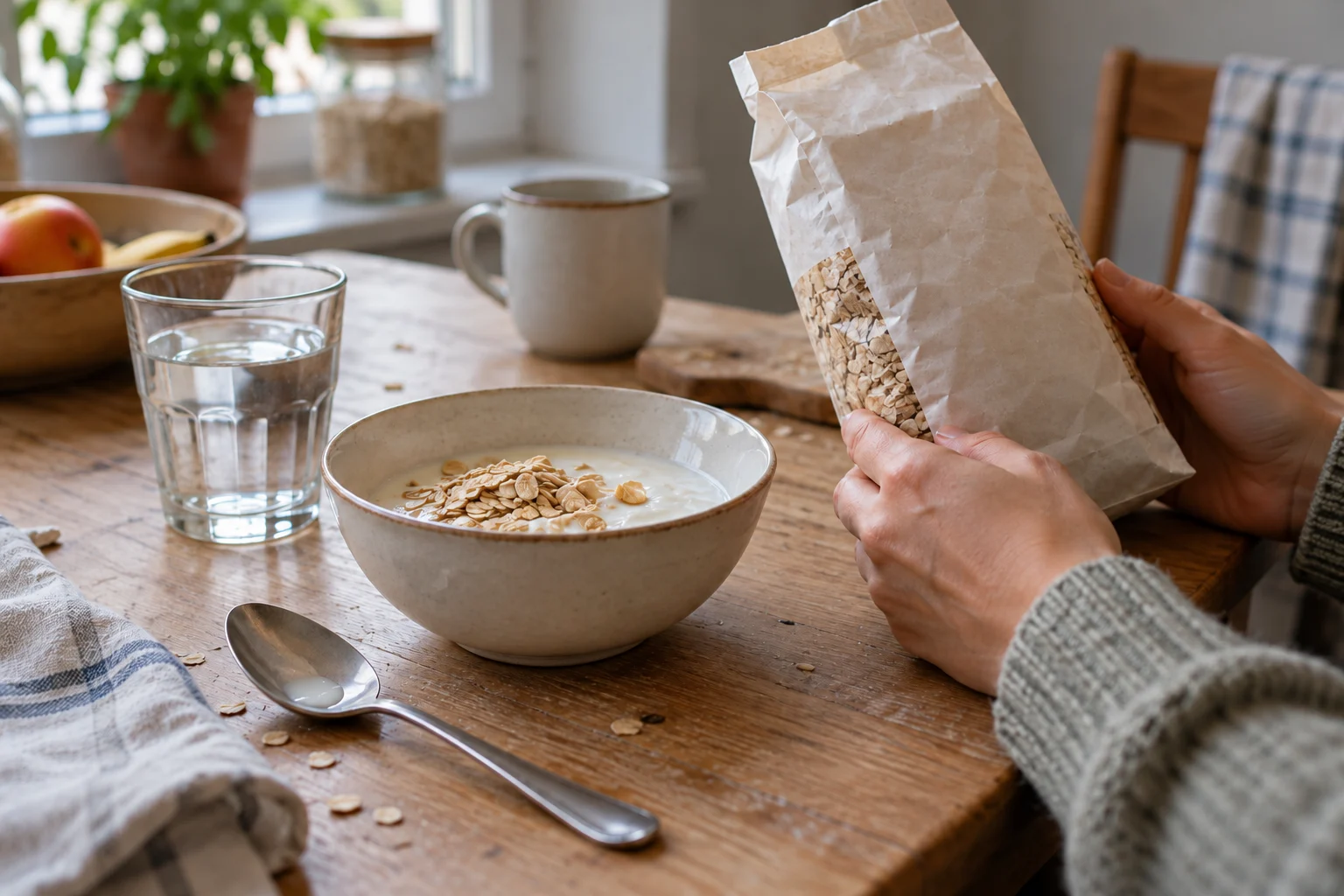
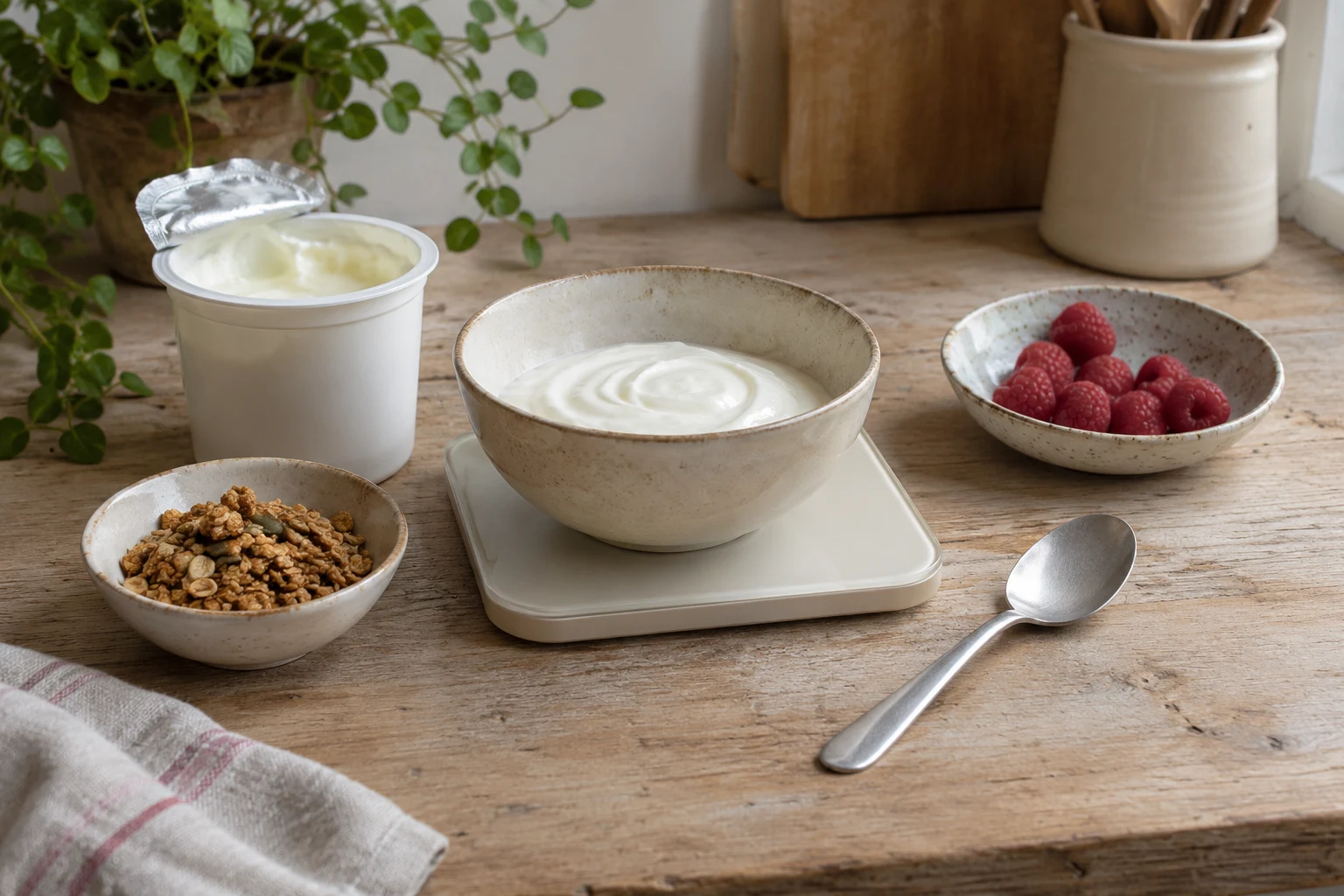
A yoghurt bowl is easier to log when you keep the base and toppings distinct. Note the amount of yoghurt, granola, fruit and any extras before mixing them. The total weight of a finished bowl is not the weight of yoghurt alone.
This is especially useful when breakfast comes from several containers: a shared tub in the fridge, a bag of granola and whatever fruit is on the counter. You can enjoy the same simple breakfast while making the entry more representative of what you ate.
Start with the base you actually used
Keep the yoghurt tub nearby while you prepare your bowl. Plain, flavoured and different fat-level yoghurts can have different nutrition values, so match the product rather than choosing a familiar-looking name.
The NHS food-label guide explains that nutrition information is given per 100 g or 100 ml and sometimes per portion. It also notes that the manufacturer's portion may differ from yours. Our per-100-g and per-portion guide covers the label calculation in more detail.
For a concrete label example, FAGE Total 0% in the UK lists 54 kcal per 100 g. A 150 g amount of that specific yoghurt corresponds to 81 kcal before toppings. This is a calculation from a published label, not an analysis of the breakfast photograph above. Use your own pack if the product, country or formulation differs.
Use the scale before mixing
If you want measured quantities, a kitchen scale can help you keep the components separate without using a different bowl for each one.
- Put your empty bowl on the scale and use its zero or tare control.
- Add the yoghurt and note its weight.
- Zero the scale again, add the granola and note that weight.
- Repeat for fruit or another topping, then mix your breakfast.
Follow your scale's instructions for its tare control. The useful record is the amount of each ingredient, not the bowl's weight. You can jot the amounts down while preparing breakfast so you do not have to remember them afterwards.
Tare does not decide a serving for you. It simply makes the display start again from zero while the bowl and previous ingredients remain on the scale.
Keep toppings with their own values
Use the granola packet for the granola, rather than applying the yoghurt's label to everything. Do the same for packaged nuts, seeds or other additions. Fruit remains a separate component even if it disappears beneath the yoghurt when you stir.
Avoid multiplying the yoghurt entry by the total weight of the finished bowl. That changes the amount of yoghurt represented in the calculation; it does not turn some of it into granola or berries.
An easy preparation note might list just four things: the yoghurt product, its amount, the topping names and their amounts. There is no need to give every breakfast the same recipe. The aim is to describe this bowl.
Review a meal photo with those details in mind
In Nourri Nutrition, use Scan meal to start from a photo, then review the recognised foods and portions before saving. Your packet and preparation notes give you something concrete to compare with the estimate.
Check whether the result represents the yoghurt and the toppings you used. A photo cannot reliably show the amount of every ingredient hidden under another, and a calorie estimate is not guaranteed to reproduce a packet calculation exactly.
A portion adjustment scales the stored meal estimate. It should not be treated as a way to add a missing ingredient or change the recipe. Our portion estimate guide explains that distinction; the mixed-meal photo guide covers reviewing a meal with several components.
Make the next bowl easier to record
If you often use the same breakfast ingredients, keep the packs together when you prepare it and note only what changed: a different yoghurt, another topping or a different amount. For a bowl already mixed, record what you know and recognise where the quantities are approximate.
Start with your next familiar breakfast. Keep the base and toppings distinct, review the entry and save the meal. A useful record can be simple without pretending every number is exact.