Read the quantity before the number
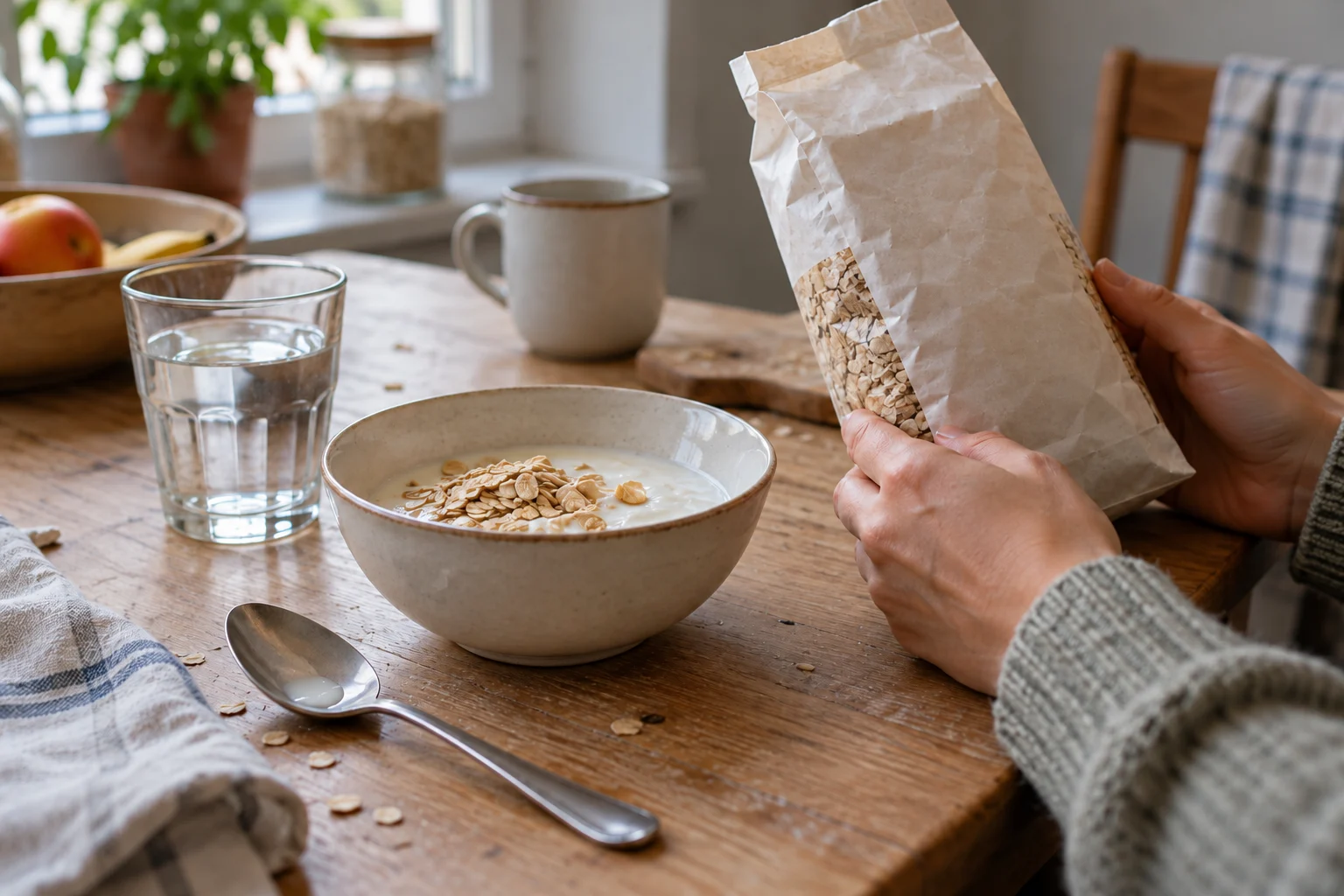
At breakfast, a packet of oats might show one energy value per 100 g and another for a portion. Both can describe the same food. The difference is the amount each column refers to.
For most prepacked foods in the EU, the nutrition declaration gives values per 100 g or 100 ml. Information per portion may appear alongside it, according to the European Commission's nutrition-labelling guidance. That common reference makes quantities easier to compare.
This guide focuses on reading EU-style labels. Europe includes countries outside the EU, so check the actual packaging and local guidance where you shop.
Find the column that matches your task
Use the per-100-g or per-100-ml column when you want a consistent reference quantity. Use the portion column only after checking the amount that the manufacturer calls one portion.
A portion on a packet might be one slice, a stated weight, or part of a container. It is not automatically the amount you have put in your bowl.
Before you calculate, ask:
- Is the value for 100 g, 100 ml, one portion, or the whole pack?
- What quantity am I actually eating or drinking?
- Does the label describe the food as sold or after a stated preparation?
That last question matters for foods prepared with water, milk or other ingredients. Read any preparation note beside the table, and keep the reference consistent.
A simple calculation for the amount you eat
Imagine a fictional food label showing 360 kcal per 100 g. You weigh 45 g of that food.
360 × 45 ÷ 100 = 162 kcal
The same calculation works for a nutrient expressed in grams per 100 g. If the fictional label lists 12 g of protein per 100 g, the corresponding calculation is:
12 × 45 ÷ 100 = 5.4 g of protein
These are arithmetic examples, not the nutrition values of the breakfast pictured or a particular brand.
| Reference on the label | Amount used | Calculation |
|---|---|---|
| Per 100 g | 45 g | Label value × 45 ÷ 100 |
| Per 100 ml | 150 ml | Label value × 150 ÷ 100 |
| Per 30 g portion | 45 g | Label value × 45 ÷ 30 |
Keep mass and volume separate. A value per 100 ml needs an amount in millilitres; a weight in grams is not automatically interchangeable.
Keep the rest of the meal in view
A packet usually describes its own contents. If you add yoghurt, milk, fruit or a spoon of nut butter, those ingredients become part of the meal you are recording.
For example, the calculation for dry oats does not also describe the milk you pour over them. Equally, if the package explicitly gives values for a prepared serving that already includes a stated amount of milk, understand that reference before adding the same milk again.
You do not need to turn breakfast into a spreadsheet. A clear idea of the foods and their amounts helps make the entry understandable when you look back at it.
Review your meal in Nourri Nutrition
In Nutrition, photograph the meal and review the foods, portion and estimated values before saving. A scan becomes a Meal in your daily log when you save it.
Keep the packet available as a separate reference. Check whether the estimate describes the same food and quantity, and whether additions such as milk or toppings have been accounted for. The label calculation gives you context for that review; it is not a promise that a meal photo will reproduce a package value exactly.
For an already saved Meal, the edit screen lets you change its name and portion. A portion change scales the stored calories and macros; it does not run a new scan or change the underlying ingredients. Use that adjustment when the food composition is the same and the amount has changed. Our portion-size guide explains that distinction.
Start with one familiar meal in Nourri Nutrition: read the quantity on the packet, review the meal, and save an entry you can understand later.