kcal and kJ both measure the energy in food. They use different units: 1 kcal equals 4.184 kJ. When a packet shows both, you are looking at the same energy expressed two ways. Do not add the two numbers together.
For a meal log that displays kcal, read the kcal figure on the packet. If your source gives only kJ, divide by 4.184. Before comparing any figures, check that they describe the same amount of food.
What do kcal and kJ stand for?
kcal means kilocalories; kJ means kilojoules. In everyday food conversations, “calories” usually refers to kilocalories. The NHS guide to calories explains these labels and why the body needs energy to function.
The larger kJ number does not mean a second kind of energy or an extra ingredient. Think of a journey described in kilometres and miles: changing the unit changes the number, not the journey. Likewise, the same yoghurt can have both an energy value in kJ and one in kcal.
How to convert kJ to kcal
The Swedish Food Agency's nutrition information guide gives the conversion between these units. Use:
- kJ to kcal: divide the kJ figure by 4.184.
- kcal to kJ: multiply the kcal figure by 4.184.
Here is a worked example, rather than the label of a particular product. Suppose a serving is listed as 840 kJ. Dividing 840 by 4.184 gives approximately 201 kcal. That serving is not 840 kcal, and it is not 1,041 units of combined energy.
For the reverse calculation, 200 kcal multiplied by 4.184 equals 836.8 kJ. You do not usually need this calculation when both units are already printed on the pack. Read the unit you need instead of converting it again.
Keep the quantity beside the unit
A unit conversion does not change the quantity of food. Converting 840 kJ per 100 g gives about 201 kcal per 100 g, not the energy in any bowl you happen to serve.
If the worked-example food is served in a 150 g portion, that is one and a half times the 100 g reference. Its energy would be approximately 301 kcal: 840 × 1.5 ÷ 4.184, rounded at the end. The portion and the unit are two separate checks.
The NHS food-label guide explains that nutrition information is given per 100 g or 100 ml and may also be given per portion. Our guide to per-100-g and per-portion values takes you through choosing the right column.
Check the unit before reviewing a meal entry
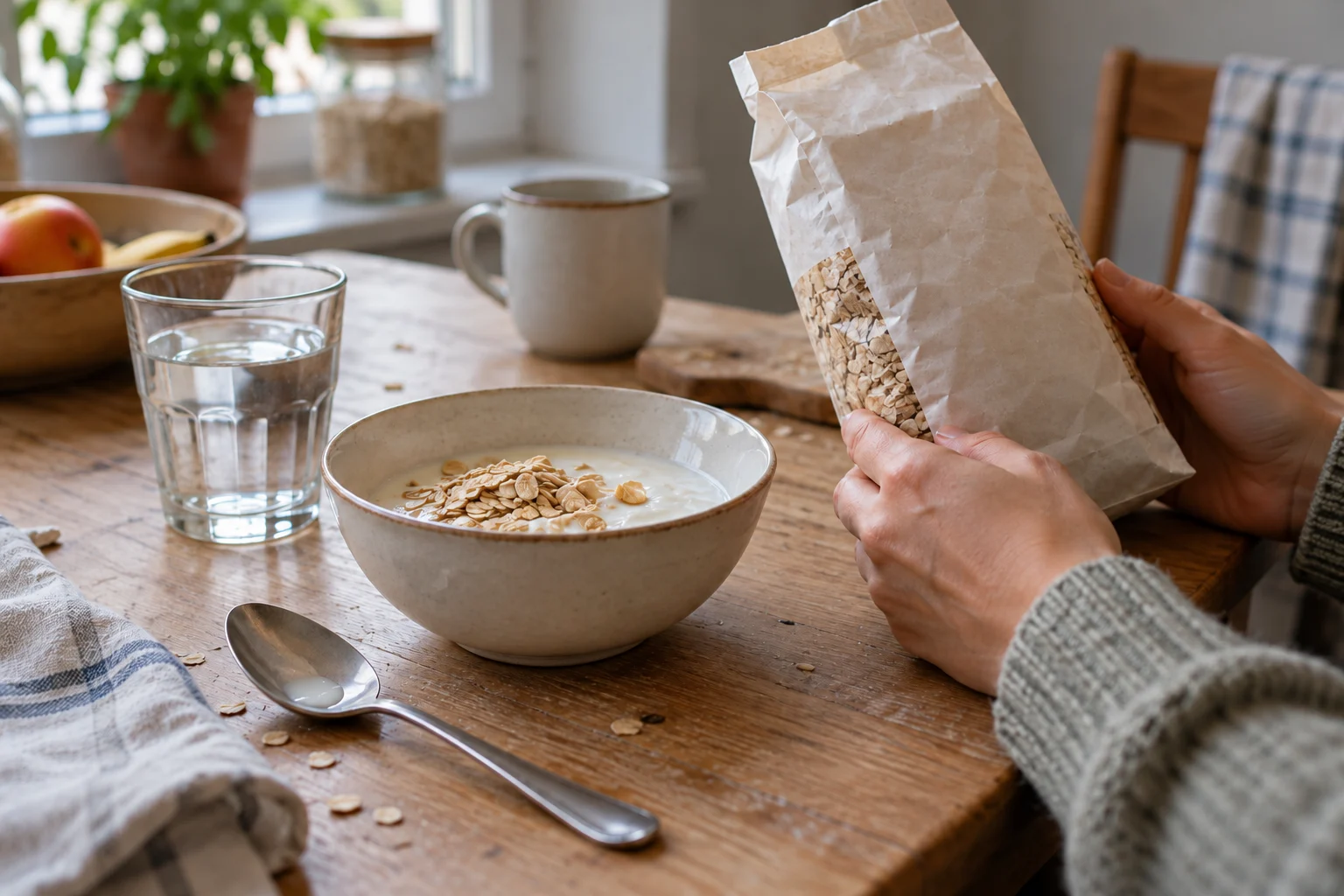
Imagine checking a breakfast entry against a packet in your kitchen. The packet's larger energy number catches your eye, while your meal log shows a smaller kcal estimate. Before assuming the estimate is wrong, read the letters beside both numbers.
A useful order is:
- Find the energy line and identify kJ or kcal.
- Check whether the value is per 100 g, per 100 ml or per serving.
- Match the quantity and the food, including whether the label describes it dry or prepared.
- Compare like with like, allowing for any milk, toppings or other ingredients in the meal.
In Nourri Nutrition, meal entries display estimated calories in kcal. After a meal photo, review the foods and portion before saving. Keep the packet as a separate reference; a photo estimate is not guaranteed to reproduce its value exactly.
For a saved meal, changing the portion scales its stored calories and macros. Do not use that multiplier merely to make a kcal number match a kJ number. A unit mismatch calls for a conversion, not a larger serving. See how portion changes affect estimates for the distinction.
What the energy number can tell you
An energy value answers one question: how much energy is associated with this stated quantity? It does not describe the whole meal. The food-label guide also points readers to information such as fat, sugars, protein and salt.
For your next label check, start with the small letters next to the number. Read the unit, match the quantity, then review the meal. That is enough to avoid confusing a kilojoule figure with a calorie figure.
Sources and further reading
- NHS: Understanding calories
- Swedish Food Agency: Nutrition declaration and energy conversion
- NHS: How to read food labels