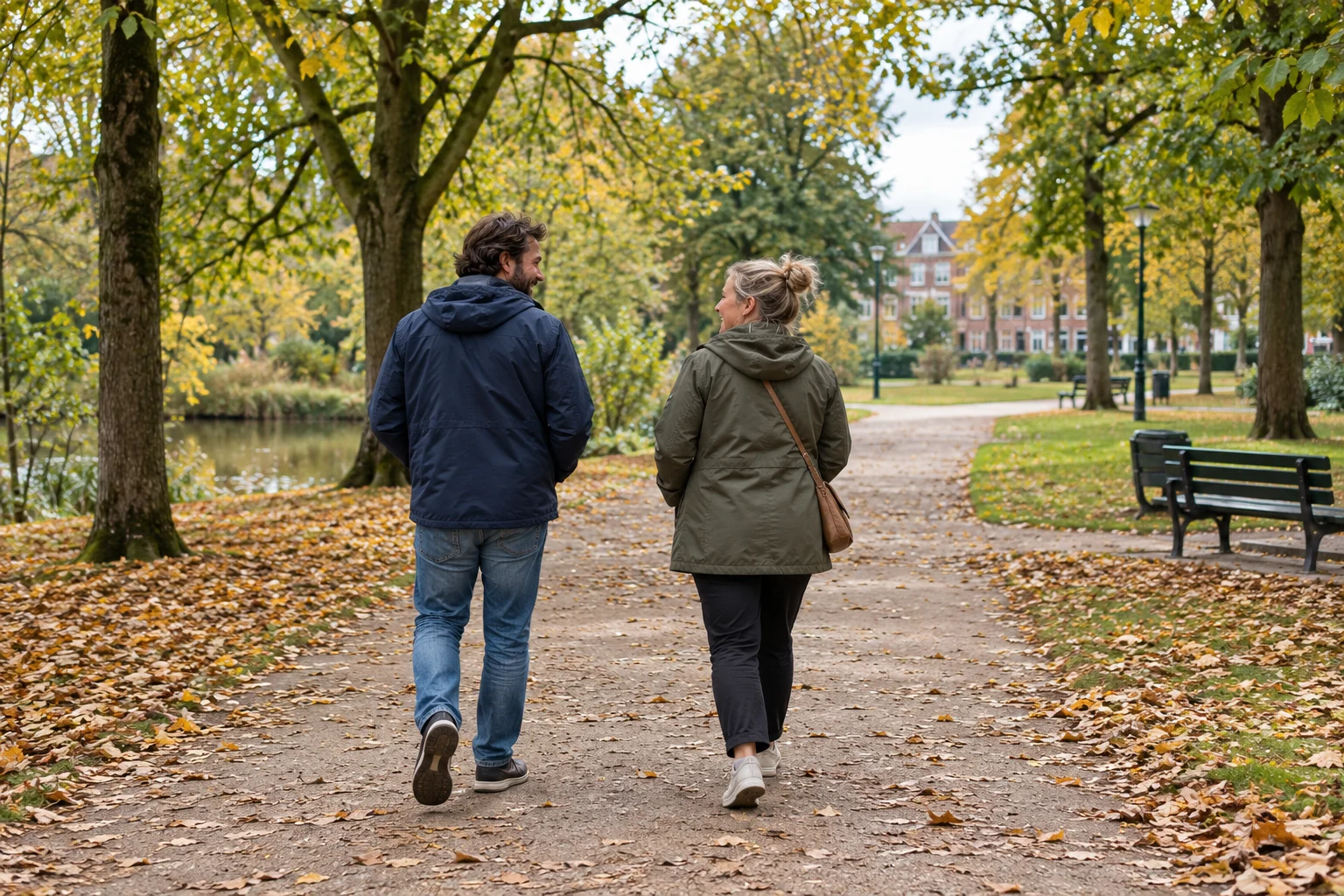
Brisk walking is about effort, not one speed everyone must reach. A useful talk test for moderate activity is that you can talk but cannot comfortably sing. A leisurely stroll may feel easier; the same walking speed can feel different to different people.
That makes conversation a practical starting point on a lunchtime loop, a walk to the shops or the stretch between home and the tram stop. You do not need to turn every outing into a pace challenge.
How the walking talk test works
The CDC guide to activity intensity describes the talk test as a simple way to judge relative intensity. During moderate activity, you can talk but not sing. During vigorous activity, you can say only a few words before pausing for breath.
On a clear, familiar section of your walk, notice how an ordinary conversation feels. Can you speak comfortably while your breathing is a little quicker? Would singing feel difficult? That is the practical distinction behind the test. There is no need to sing aloud on the pavement.
If conversation has become a few words between breaths, the effort is higher than the moderate level described above. Ease the pace if a moderate walk is what you intended. The talk test is a guide to effort, not a diagnosis or an individual training prescription.
Why there is no single brisk walking speed
Relative intensity depends on the person. The CDC notes that an activity can feel vigorous to one person and moderate to someone with a different fitness level. An app's speed figure cannot make that comparison for you.
Imagine two friends taking the same park loop. They cover the same distance together, yet one finds conversation easy while the other needs frequent pauses. Matching each other's speed does not necessarily mean matching effort.
Likewise, a number from a previous outing is not an instruction for today's walk. Use the route and time as context, then pay attention to how the movement feels. You can slow down, pause or choose an easier section without treating the outing as a failed attempt.
Try it on a walk you already make
Choose an everyday journey with a straightforward section where you can pay attention to walking. A quiet stretch of pavement or a familiar park path can be more practical than a crowded station entrance.
- Begin at a pace that feels manageable.
- When the path is clear, notice your breathing and ability to talk.
- Adjust your pace to the effort you intended, rather than chasing a number.
- Slow down or stop for crossings, crowds and changes in the surface.
This is a way to notice effort during an ordinary outing, not a requirement to keep the same pace from door to door. A shopping stop or pedestrian crossing belongs in the journey too.
The NHS walking guide recommends comfortable shoes with adequate support. If you are not very active but can walk, it advises building up walking distance gradually. Brisk walking can help build stamina and support heart health.
Does a slower stroll still count?
Yes: a gentler walk is still movement. It may not reach moderate intensity for you, but that does not make it pointless. WHO's physical activity guidance emphasises that all physical activity counts and some is better than none. It also identifies benefits from muscle-strengthening activity, so walking can sit alongside other kinds of movement.
There is room for different walks in the same week: a relaxed catch-up, an errand and an outing where you deliberately notice a brisker effort. Choose the purpose before judging the pace.
Record the outing, then read the numbers in context
In Nourri Active, open Move, choose Walk and wait for GPS to be ready before starting an outdoor recording. Finish and save the activity when you return. A familiar route gives you a simple outing to revisit.
The saved time and distance describe the activity; they do not confirm that every minute was moderate intensity. For stops along the way, our moving time and elapsed time guide explains why two durations can describe one outing.
In autumn, leave the pace decision separate from the route decision. Our short daylight walk guide helps you plan around local daylight and access. For your next walk, choose somewhere familiar, notice how conversation feels and save the outing when you finish.